Today’s Case
Oliver is waiting in the waiting room of a clinic.

Oliverさ~ん。
Oliver-san.
(Oliver.)

はい。
Hai.
(Yes.)
診察室へ お入り ください。
Shinsatsushitsu e ohairi kudasai.
(Please come into the consultation room.)
「お入り ください」か。
“Ohairi kudasai” ka.
(“Ohairi kudasai,” huh.)
「お入り おねがいします」でも正しいのかな?
“Ohairi onegaishimasu” demo tadashii nokana?
(I wonder if “ohairi onegaishimasu” would be correct, too?)
Decoder’s Notes

It looks like Oliver thinks that;
“ください (kudasai)=please” and “おねがいします (onegaishimasu)=please”.
So, is “お入り おねがいします (ohairi onegaishimasu)” correct, too?
In English, both “ください (kudasai)“ and “おねがいします (onegaishimasu)“ can often be translated as “please.”
So, does that mean “お入り おねがいします (ohairi onegaishimasu)” is correct, too?
Today, let’s solve this mystery together!
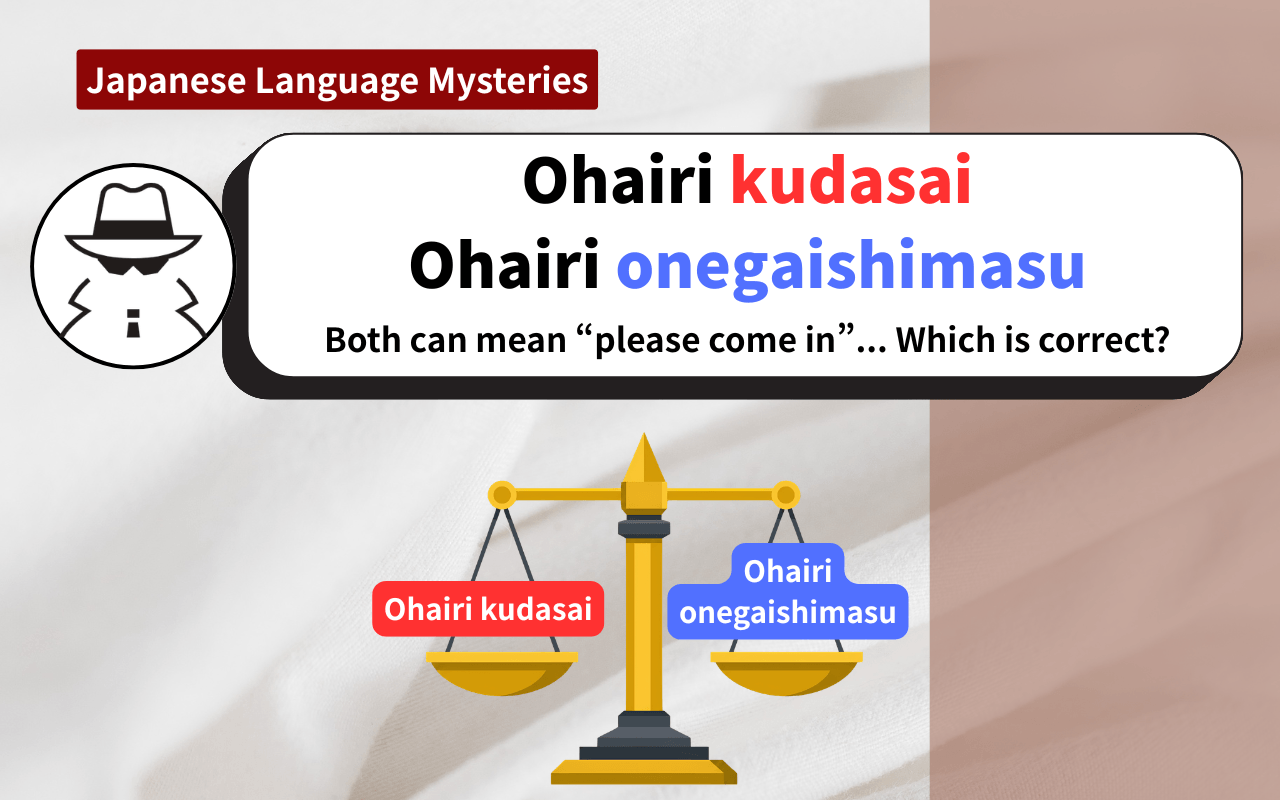
“お入り ください (Ohairi kudasai)“
“お入り おねがいします (Ohairi onegaishimasu)“
To explain the difference between these two expressions, let’s use let’s use the following simple rule of thumb for now:
“ください (kudasai)“ → often used together with a verb
“おねがいします (onegaishimasu)” → basically used with a noun
That’s it!
The key word here is “お入り (ohairi).” “お入り (Ohairi)“ comes from the verb “入る (hairu)”, meaning “to enter,” and is a respectful expression used when referring to someone else’s action. You don’t need to worry about the detailed grammar here. Just remember:”お入り (ohairi)” originally comes from the verb “入る (hairu).” That’s enough for now.
Since “お入り (ohairi)” comes from a verb, we use “ください (kudasai)” in this case. Thus, “お入り ください (ohairi kudasai)” is a polite way to ask someone to enter.
So:
“お入り ください (Ohairi kudasai)” →〇
“お入り おねがいします (Ohairi onegaishimasu)” →×
The Clue
There are many other expressions that follow the same pattern as “お入り ください (ohairi kudasai)”. For example:
- お書きください (Okaki kudasai): “Please write it down.”
- おかけください (Okake kudasai): “Please have a seat.”
- お待ちください (Omachi kudasai): “Please wait.”
Wait a minute.
When I want some water at a convenience store or restaurant, I can say: “水、ください (mizu, kudasai)“, which means “can I get some water?”
“ください (kudasai)“ → often used together with a verb
“おねがいします (onegaishimasu)” → basically used with a noun
That’s what we learnt here.
In “水、ください (mizu, kudasai)“, “水 (mizu)” is a noun, but we’re still using “ください (kudasai)“. So what’s going on?
Actually, there is another rule hiding behind “ください (kudasai)” and “おねがいします(onegaishimasu)“.
“お入り ください (Ohairi kudasai)” and “水、ください (mizu, kudasai)“
They both use “ください (kudasai)“, but something is different. We’ll uncover that mystery in the next case.
Today’s Field Mission
Next time you’re out in town or watching a Japanese TV drama, listen for situations where you hear:
“ください (kudasai)“ and “おねがいします (onegaishimasu)“
What words come before them?
Case Solved
Today’s case is solved… Well, not quite.
There’s still one mystery left: Why can we say “水、ください (mizu, kudasai)”?
See you in the next case!